A Comprehensive Guide for Bat Box Designs, Placement, Location, Color, Climate, Time of Year, and Whether You Should Install One in the First Place
by Colin Eldridge, NTNC Docent
We recently heard from someone who attended our Going Batty program and went home inspired to put up a bat box in his own backyard. He had some genuinely good questions, the kind that don't always have simple answers. Here's what he asked:
Hello,
My kids and I camped at Lake Cachuma last summer and attended your Going Batty program - we loved it. We would like to have our own bat box - insect control and the kids just think they’re cool. I was thinking of installing a bat box on one of our oak trees (up 15-20ft). Behind me is facing north. Is there a better direction to face the bat box and color (natural vs black) - right temperature for the right time of year - or one of each so the potential bats can be happy in summer and winter? Any other tips for initially attracting them, or in general, would be appreciated as well. We’ve seen bats flying around the yard in the summer when the sun goes down.
Thanks,
Chris
We didn't know how to answer some of these questions right away, so we dug deeper and decided to write this article as a guide to anyone who's curious about installing their own bat box.
A quick Google search will turn up plenty of bat box guides, but we wanted to offer something grounded in research, and to emphasize that there’s no one-size-fits-all approach. What works best will depend on your specific location and conditions, and every setup is a little different. Many online bat box guides (even from .org and .gov websites) are often generalized and might not cite sources, so it's worth approaching online guides—including this one—with a healthy dose of skepticism.
Keen observation, local research, including asking folks in your area who have experience working with bats, and a bit of trial and error can go a long way. The goal of this article is to provide a solid starting point, helping you think through the process and point you in the right direction for setting up your own bat box.
1. Should I install a bat box?
First and foremost, bat boxes might not be the best conservation method in all cases. According to the US Wildlife and Fish Service and an article from the University of Illinois, land owners should first consider more natural ways to support bat populations, such as planting native trees or wildflowers to attract insect prey, providing clean water sources, or leaving standing dead trees where it is safe to do so, as these serve as natural roosting habitat for many of the same bat species that use artificial boxes.
If you're in a situation where none of the above options are available, and natural habitat in your area has largely been lost, a bat box might be worth exploring. The same goes if bats are already roosting somewhere on your property that poses a safety concern, like a garage or roof. But keep in mind that installing a bat box is a big commitment that requires careful planning and research, and doing it properly is important in order to protect bats, humans, or other animals.
First, consult your local wildlife authority, as disturbing bats at the wrong time of year or interfering with an endangered species can be harmful and illegal. Once you've identified the species and received approval, a bat box installed away from human activity can make a more suitable roost, and bats may move in on their own. If needed, an exclusion barrier installed outside of mating season can encourage the transition. Bats may actually take to it readily, since a well-designed box installed further away from human activity might make a more suitable roost.
2. Weigh the potential pros and cons of bat boxes
Pros
- Bat boxes are a viable conservation option when natural habitat alternatives are not available in your area.
- Bats are highly effective natural pest controllers, consuming thousands of insects per night.1
- Supporting native bat populations can contribute to the health of your local ecosystem.
- Bat guano is a nutrient-rich natural fertilizer.
- Bat boxes are relatively inexpensive and low-maintenance.
Cons
- It may be illegal to remove bats once they move in, especially for endangered species and during bat mating or birthing season. 2
- Bat guano that accumulates beneath the box and can pose health risks if not managed properly.3
- Once bats have taken up residence, relocating the box or disturbing the bats can cause serious harm to the colony.
- Bats can carry rabies and other transmissible diseases. There are more deaths from lightning strikes than from rabies each year in the USA because of robust rabies prevention efforts, but the risk is not zero.4 If you think you may have been exposed to a rabid animal, go to the hospital right away.
- It may take months or years before bats move in, if at all.5
- Neighbors or family members may be uncomfortable with the idea.
- Placement requires careful thought to avoid conflicts with human activity.
- If installed incorrectly, bat boxes can harm bats (i.e killing pups from overheating or causing bats to overlook better-suited natural habitat).
- Bat boxes require occasional maintenance and monitoring.
3. Ask yourself these questions:
- Do any buildings on my property have holes larger than a dime or cracks larger than a quarter inch? If so, bats may already move in on their own. That's worth knowing if you don't want them moving in, whether or not you're installing a bat box.
- Does my town, city, or neighborhood have regulations regarding bat boxes? Contacting your local animal control or wildlife agency is a good place to start.
- Are my neighbors OK with me installing a bat box, and do they have any preferences on how far away the box is from their property?
- Do I have small children or anyone with a compromised immune system or heightened health risk in my household? They should be educated about the risks of transmittable diseases from bats and their guano (droppings), to keep their distance from the bat box, and to never directly touch bats, even if one is found on the ground.
- Do I have outdoor pets? They should be kept indoors, away from the bats and their droppings.
- Have I done adequate research to make sure I build and install the bat box correctly so that I don't harm bats, humans, or other animals?
- Am I ready to regularly monitor bat box temperatures to prevent the bats from overheating?
- Am I prepared for the long-term commitment?
4. What direction should the bat box face?
- This is an important question without a simple answer. The goal is to maintain a comfortable internal temperature for the bats, neither too hot nor too cold, and how much direct sunlight the box receives plays a significant role in that.
- Research suggests that internal box temperature depends on a combination of factors, including the box orientation, mounting surface, local climate, and how those elements interact to influence the box's internal temperature. 6
- Rutgers University Wildlife Publications suggests to face bat houses south or southeast for 6–8 hours of sun (morning sun preferred) to help maintain roost temperatures above ~85°F; in cooler or dry climates try back-to-back boxes on a pole or building-mounted setups to buffer temperature swings, and in hotter or humid climates consider back to back, one light colored box facing north and one dark colored box south. 7
- Consider local environmental conditions such as air temperature, sun, and wind speed when selecting box design and placement.
- If you're placing multiple boxes, try a variety of sun exposures. Place multiple boxes close together with full shade, partial sun, and full sun can all be tried to meet bats' changing needs throughout the maternity season.
- If you're placing just one box, be careful to avoid placing boxes that will overheat, as this can kill bats, especially pups.
5. What color should the bat box be?
- Color has a dramatic effect on internal temperatures. In one study, sun-exposed boxes with a black color had temperatures 36°F (20°C) higher than the ones painted white, compared to only a 7.92°F (4.4°C) difference boxes of the same colors placed in full shade. 8
- The maximum temperature threshold researchers have identified is 104°F (40°C). Above this temperature, most bat species are significantly heat-stressed, and researchers have observed bats in natural roosts moving to avoid temperatures above 97°F.9
- Bat box color alone is not enough to make the bat box stay within safe temperatures. Location, orientation, and insulation also matter.10
- Rutgers University Wildlife Publications suggests in hotter or humid climates to consider back to back pole-mounted bat boxes, one light colored box facing north and one dark colored box south, to give the bats a range of thermal options.
- Dark-colored bat boxes can make overheating a serious risk, yet some companies continue to market black boxes as bat-friendly and appropriate across most of the United States. A single sweltering summer day inside a small, dark box could be fatal to any bats roosting there. Bat deaths in dark-colored boxes even in cooler climates have been observed.9
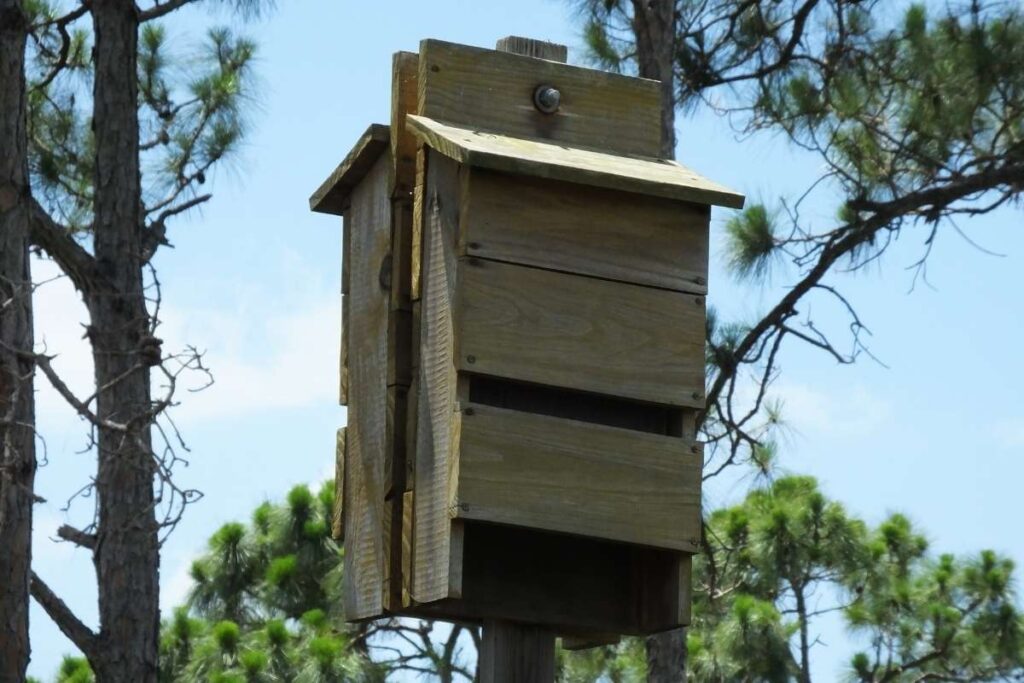
Some publications and websites offer a bat box color regional map, but many of them are outdated (over 10 years old) and might not take into account climate change and rising maximum temperatures. Amanda M. Adams, Ph.D., the director of Research Coordination at Bat Conservation International, shares:
"The Bat House Builder’s Handbook is outdated and does not include the recent research on bat houses. We are now more concerned about high temperatures and the risk of bats overheating than when the Handbook was published. Previously, Oregon’s max temperature was 83°F, but in 2021 it was 119°F, and last year it was 101°F. I’m hesitant to recommend that anyone paint a box black anymore.
Our current paint color recommendation is based on the recent research from Dr. Joy O’Keefe’s lab at the University of Illinois Urbana-Champaign https://wildlife.nres.illinois.edu/safer_bat_boxes_2/
Our goal is to update our website to reflect the most current research as it is published. The map is a nice tool, so I will see what we can do to create an updated one."
6. What time of year is best for installing a bat box?
- It is suggested to install a bat box in the spring, before migrating bats return during the warmer months.11 Keep in mind that no matter when you install your bat box, it might take bats multiple months or years to move in, if at all.
- If you're installing an exclusion barrier to remove bats from a building, it's important NOT to do this during their mating or birthing season, and to have your bat box installed beforehand12. Install the bat box at least 2 weeks before bat exclusion, so that the bats have time to familiarize themselves with the new structure.
7. How to build a bat box
- There are lots of different designs, as well as pre-made bat boxes that you can buy. Perhaps the best place to start is by checking with your local wildlife organizations and universities, as well as seeing if there are any successful bat boxes in your area, and find out how they built it or where they bought it.
- Thicker wood will insulate boxes for temperature control
- Rocket Boxes have a higher temperature variation within them, providing a better opportunity for bats to avoid overheating.
- Avoid toxic building materials, such as chemically treated wood or VOC-emitting paints and sealers.
- Here are some online guides:
Please check the year of the bat box guide you are reading. Some recommendations, such as for bat box color, may be outdated and not take into account rising global temperatures.
Want to buy a bat box instead? HabitatForBats.org offers a bat box shop and an excellent bat resource page
8. Where is the best place to install a bat box?
- Typically, a bat box is mounted on a pole or on the side of a building, at least 12 feet above the ground.
- Some organizations and studies advise against mounting bat boxes on trees, while others suggest that tree-mounted bat boxes can be a viable option (more on this below).
- Bat box guides can vary widely online, and much of it likely comes down to the preferences of your local bat population.
- Dead or decaying trees that pose no safety risk are worth leaving in place, because they make excellent natural habitat for bats, birds, and many other wild animals — no bat box needed!
- Bat guano will accumulate beneath the box once bats take up residence, so placement is important.
- Avoid positioning the bat box anywhere near human activity and pets, including neighbor's pets! If possible, keep the bat box at least 20 feet away from entrances, pathways, and high-traffic areas.
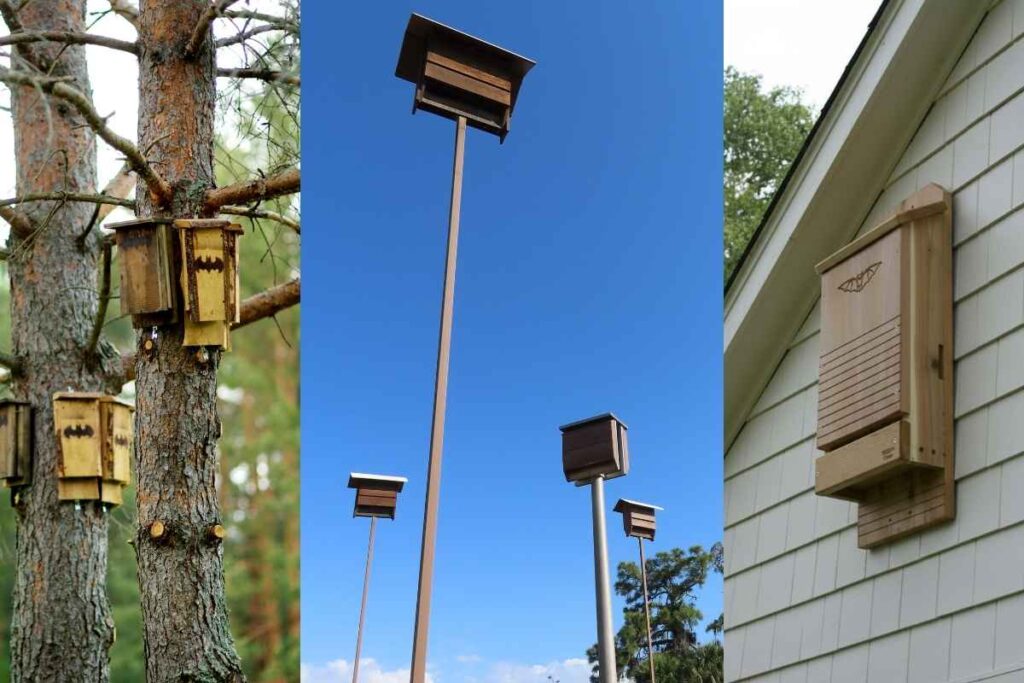
There’s a surprising amount of disagreement when it comes to mounting bat boxes on trees. Some organizations strongly recommend installing bat boxes on poles or buildings instead for a variety of reasons. Others argue that tree-mounted bat boxes can still be effective in the right conditions. Curious about the conflicting recommendations, we decided to dig deeper into the research, expert opinions, and scientific studies surrounding tree-mounted bat boxes to better understand what the evidence actually says.
The Bat Conservation Trust, a UK-based organization, notes that while bat boxes cannot replace the diversity of natural tree cavities and roosting features, they can still provide valuable additional habitat for a variety of bat species. The organization also states that bat boxes can be mounted on trees and emphasizes that healthy bat habitat depends not only on shelter, but also on access to food, water, and supportive surrounding ecosystems. 13, 14
We asked local bat expert Paul Collins from the Santa Barbara Museum of Natural History, he helped us identify our bat colonies at the nature center. Here's what he had to say:
"I am afraid I cannot help you with your questions about the value of attaching bat boxes to trees. I do not have any direct experience with where and how man-made bat boxes should be attached to allow bats to safely access and to protect bats that use these boxes from other critters getting into the boxes. Some crevice roosting bats like California Myotis are known to roost under exfoliating bark on tree trunks while others use hollows within trees to roost during the day and in some case as maternity roosts. Migratory bats like Western Red Bat and Hoary Bat are known to roost on the branches and surface of the bark of trees during the day. Hope this helps.."
Bat Week, an organization dedicated to awareness about the critical role bats play in ecosystems, claims that branches can block sunlight needed to warm the bat box, predators can sit on branches and hunt bats as they exit the bat box, and the tree trunk and branches can obstruct bats from dropping from the bat box. Bat Conservation International, an organization dedicated to conserving the world’s bats and their ecosystems to ensure a healthy planet, says that bat boxes on poles or buildings are preferred to trees.15
We reached out to Bat Conservation International and got a response from Amanda M. Adams, Ph.D., their director of Research Coordination, who echoed a similar line of thinking:
"The main reasons we give for not mounting a box to a tree are that this makes bats more accessible by predators like snakes and raccoons, and that live trees will offer shade that may make the house less suitable for bats seeking warm temperatures. One good reason to place a box on a tree is that a tree will add supportive thermal mass, thereby presumably supporting warmer temperatures at night and cooler temperatures during the day. That being said, Stephen Griffiths detected 30 dead pups in a dark green box installed on a tree trunk in Melbourne, Australia, so boxes on trees aren’t immune to overheating. I checked Rueegger’s 2016 bat box review paper, and he does have a paragraph on this..."
Rueegger's study notes that bat boxes mounted on poles or dwellings tend to be preferred over those on trees, with faster and greater uptake reported. This may be due to tree-mounted boxes receiving less sunlight, being more accessible to predators, or being harder for bats to locate. Among reviewed publications, trees were the most common box host (74%), followed by poles (15%), dwellings (9%), and bridges (2%).16
A meta-analysis on bat roosts cited 44 scientific studies found bats using both natural roosts and bat boxes mounted on trees, poles, and buildings across several continents, with lots of variation depending on the location and species of bats.17 For example, a study in Costa Rica found that 100% of artificial bat roosts that simulated tree trunks were occupied. In another study done in Spain, it was found that during their breeding season, Pipistrellus pygmaeus bats roosted in building-mounted bat boxes more than those mounted in trees. However, the study had a relatively small sample size of a specific species in a specific season.
Keep in mind that these studies were conducted in specific environments and often focused on particular bat species, climates, and mounting conditions, so results may not apply universally. Finding the right bat box setup for your local ecosystem will require some research and experimentation. Given the aforementioned potential concerns, it might be worth mounting your bat box on poles or buildings rather than trees.
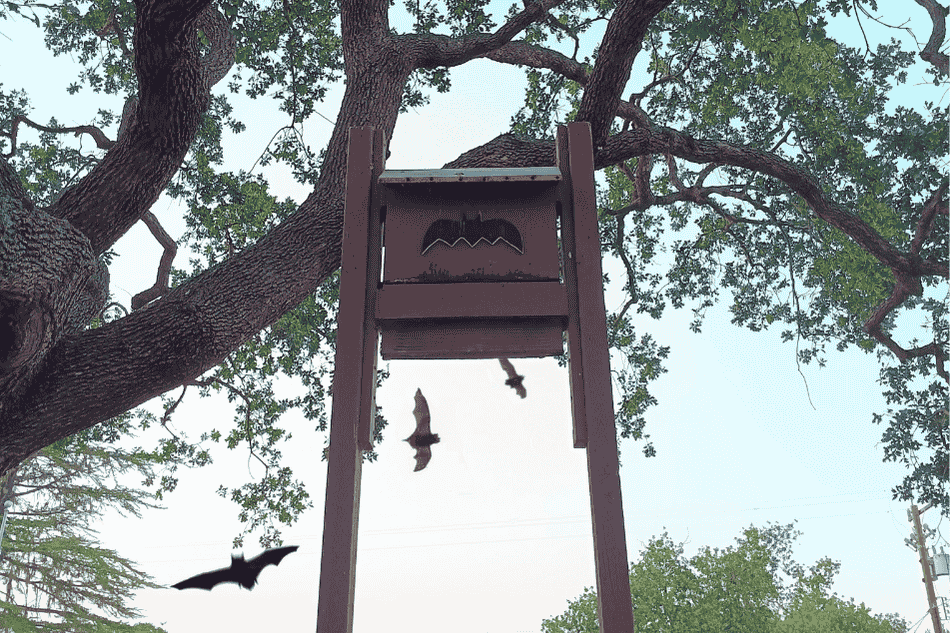
What We’ve Learned from Our Own Bat Boxes at the Nature Center
We have some insights to offer based on our experience with the bat boxes at the Neal Taylor Nature Center. Our bat boxes are installed on wooden posts, but both of them are right underneath large valley oak trees in well-shaded areas. During some summers at Cachuma Lake, the outdoor temperature can reach just over 100°F, so we think that the trees provide a microclimate for the bat boxes that helps to prevent the bats from overheating. Although overhanging branches may provide perches for owls and other predators, it hasn't stopped our colonies from thriving. In 2025, we counted a total of over 400 California myotis bats.
Before we put up the first box, the colony was already making itself a home tucked into the eaves of the Nature Center's roof and wedged into the cracked bark of a nearby Valley Oak tree. We were happy to have them around, just not quite so close to the building. Once the boxes went up, the bats made the move on their own.
California myotis are migratory bats, and many bats in the colony here seem to migrate south in the winter, but we've observed that some stay behind.
Beyond Bat Boxes: Steps Toward Conservation
There’s a lot more you can do for bats beyond installing boxes or observing them from a distance. You can advocate for habitat restoration and conservation efforts in your community, especially projects that protect native trees, wetlands, and natural roosting sites that bats depend on. Getting involved with local wildlife nonprofits is another powerful step, whether that means volunteering, donating, or simply helping spread awareness about the importance of bats and healthy ecosystems.
You can also support and help create natural habitats wherever possible. That might look like planting native species that attract insects bats feed on, preserving old trees with cavities, or encouraging land management practices that reduce pesticide use and light pollution. Even small changes in how we design and maintain outdoor spaces can make a meaningful difference for bat populations over time.
Want to learn more about bats and see hundreds of them fly out of our bat boxes? Check out our Going Batty program at The Neal Taylor Nature Center at Cachuma Lake.
We want to hear your bat questions and stories! Let us know what bats live in your neighborhood or which bat box configurations have worked for you. Email us at info@clnaturecenter.org
References
- "It's Bat Time." U.S. Forest Service. Retrieved 5/1/2026 ↩︎
- "Know the Bat Protection Laws: A Guide to Safe and Legal Bat Removal." Animal Capture Wildlife Control. Retrieved 5/1/2026. ↩︎
- "The Scoop on Bat Poop." Bat Conservation International. Retrieved 5/1/2026 ↩︎
- "Rabies in the United States: Protecting Public Health." Center for Disease Control. Retrieved 5/1/2026
Relevant finding: "From 2006 through 2021, there were 444 lightning strike deaths in the United States."
"Lightning Strike Victim Data." Center for Disease Control. Retrieved 5/1/2026
Relevant finding: "Each year, 1.4 million Americans receive healthcare for a possible rabies exposure, 100,000 receive post-exposure prophylaxis, and fewer than 10 die from rabies due to robust prevention efforts." ↩︎ - "Attracting Bats." Bat Conservation International. PDF. Retrieved 5/1/2026.
Relevant finding: "90 percent of occupied bat houses were used within two years (with 50 percent occupancy in the first year). The rest needed three to five years for bats to move in." ↩︎ - "Experimental evaluation of bat box orientation." British Ecological Society. Retrieved 3/1/2026. ↩︎
- "Guidance for Siting and Installing Bat Roost Boxes." Rutgers New Jersey Agricultural Experiment Station. Retrieved 4/29/2026.
Relevant finding: "Follow these three criteria to ensure that you have created the most attractive habitat for bats:
Face the bat house south/southeast to attain maximum sun exposure (6–8 hours/day). Most bats need temperatures >85°F to retain body heat and keep young pups warm. Morning sun is best.
If the climate is cool or dry, mounting boxes back-to-back on a pole or singly on a building will help buffer extreme temperature changes. This type of installation will provide options for bats to move in response to temperature fluctuations.
In hot climates with average or high humidity, mounting boxes back-to-back with one facing north and one facing south may increase use. Different colors of houses can also be tested, using a darker color on the south facing box and a lighter color on the north facing box."/ ↩︎ - "Day roost selection in female Bechtein's bats (Myotis bechteinii): A field experiment to determine the influence of roost temperature." Research Gate. Retrieved 4/9/2026.
Relevant finding: "Fig. 2 Temperature profiles of one shaded and one sun exposed pair of bat boxes during a warm and sunny day (17 June 1996). The maximum temperature difference between the black and the white box was about five times higher in the sun exposed pair (20.0°C) than in the shaded pair (4.4°C). After 10 p.m., all boxes reached nearly identical temperatures, independent of marked differences during the day (sunset was at 9.22 p.m.). The linear distance between the shaded and the sun exposed location was 60 m" ↩︎ - "Love bats? Think twice about that bat box, experts say." University of Illinois, Aces News. Retrieved 3/1/2026. ↩︎
- "Tips for making bat boxes safer for bats." University of Illinois Urbana-Champaign, Natural Resources and Environmental Sciences, Human-Wildlife Interactions. Retrieved 5/15/2026
Relevant finding: "Painting a box a dark color is not sufficient to produce the thermal conditions bats need. Using a dark color on the exterior of a simple bat box substantially increases the chance the box will reach lethal temperatures when placed in direct sunlight. When given the choice, bats prefer dark artificial roosts over lighter ones and they’re unable to predict the risk of lethally hot temperatures on warm, sunny days. At night, dark roosts cool just as quickly as light roosts, if made from the same material. Because paint alone doesn’t create optimal conditions, we must choose paint colors in concert with safer roost designs. For smaller boxes or those that are uninsulated, we recommend painting the box a color that is 40% dark or less (i.e., a medium-low to light brown), as these lighter colors will absorb less solar radiation and be safer on warm, sunny days. However, such a box may be chilly on cool, sunny days. To overcome this issue, we suggest building a box with high thermal mass and insulation in the outer walls and then painting this box a darker color — even black paint may be appropriate in places with cooler climates and shorter days." ↩︎ - "Guidance for Siting and Installing Bat Roost Boxes." Rutgers New Jersey Agricultural Experiment Station. Retrieved 4/29/2026.
Relevant finding: "If you are performing a bat exclusion on your property, please consider providing an alternative housing option for your bats by installing a bat house. It is best to install the bat house as close as possible to the former roost location on your home. Make sure to follow state guidelines and safe dates when performing bat evictions so that bats are not harmed. Bats in New Jersey are protected under the NJ Endangered and Nongame Species Conservation Act, and it is illegal to kill or harass bats at any time." ↩︎ - "How (and whether) to install bat boxes." U.S. Wildlife and Fish Service. Retrieved 4/29/2026 ↩︎
- "Roosts in trees - Bat roosts". The Bat Conservation Trust. Retrieved 2/8/2026.
Relevant finding: "Trees provide shelter and attract a diverse range of insect species for bats to feed on"
↩︎ - "Bats & Trees". The Bat Conservation Trust. p. 7. Retrieved 2/8/2026.
Relevant finding: "Though bat boxes cannot replace the range of natural cavities and features that trees provide, they can create additional roosting opportunities for a variety of species. Bat boxes can be fitted on trees and can be purchased prebuilt, or created from DIY designs."
↩︎ - "Bat Houses". Bat Conservation International. Retrieved 2/8/2026.
Relevant findings: "Placing a bat house away from trees or hanging branches can keep predators like owls or raccoons from reaching bats. Usually, placing a house on a pole or the side of a house is the best way to ensure this protection." "In many parts of the globe, bats depend on trees and other plants not only for roosting, but also for the fruit and nectar they eat..." ↩︎ - "Bat boxes — a review of their use and application, past, present and future." PDF. Acta Chiropterologica. Museum and Institute of Zoology PAS. ↩︎
- "Provide bat boxes for roosting bats". Conservation Evidence. Retrieved 2/8/2026.
Relevant finding: "One study in Costa Rica found that bat boxes simulating tree trunks were used by 100% of bats and in group sizes similar to natural roosts." ↩︎

Colin Eldridge
Colin is an avid naturalist and writer. He contributes to the Neal Taylor Nature Center as a docent, web designer, and photographer. He has also worked on co-creating and updating multiple Nature Center exhibits, such as the plant room, the “Going Batty” presentation and more.